
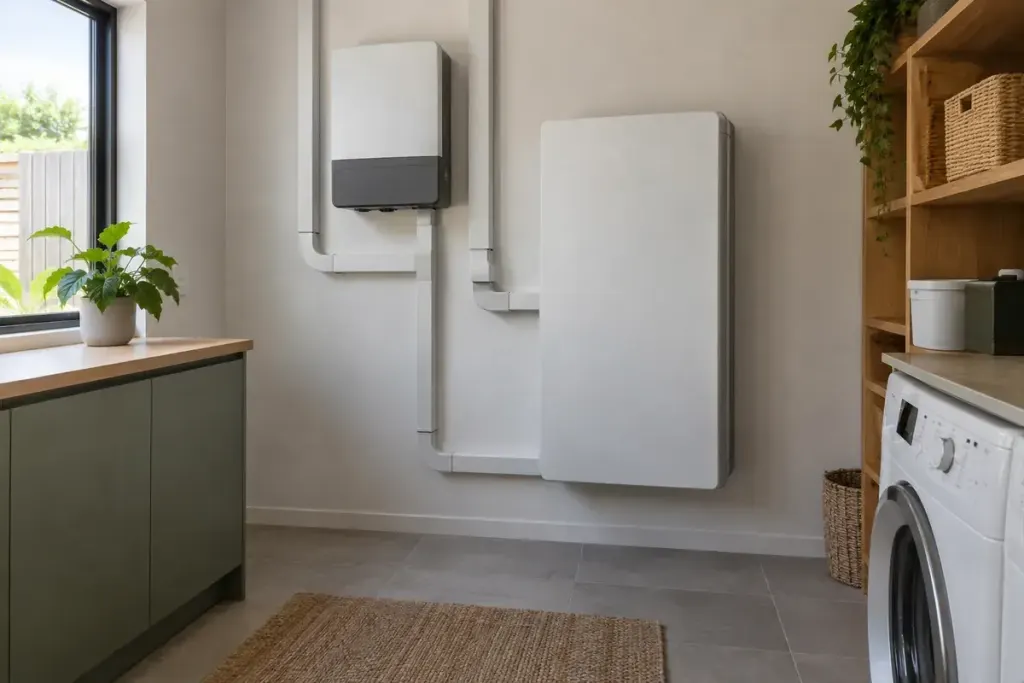
Two storage quotes can advertise the same battery capacity yet describe systems that behave differently. Before comparing prices, find two separate numbers: how much usable energy can be stored and how much power can be delivered at once.
They answer different questions. Energy is about how much is available over time. Power is about the rate at which it can be supplied. A useful quote explains both, alongside the equipment and conditions to which the ratings apply.
Read the units before the headline
Kilowatt-hours, written kWh, describe energy. Kilowatts, written kW, describe power. The Department of Energy’s solar and storage overview discusses storing energy for later use and the losses involved in doing so. Storage shifts when energy can be used; it does not make conversion losses disappear.
When a quote says “10 kWh battery,” ask whether that is nominal capacity or the usable capacity under the stated operating settings. Then find the continuous output rating. A short-duration peak rating should not be treated as an output the system can sustain indefinitely.
A deliberately simple runtime calculation
Imagine a system with 6 kWh of energy available to the chosen loads and a steady 0.5 kW demand. Dividing 6 by 0.5 gives 12 hours in an idealised calculation. This example assumes a constant load and that the stated energy is already available at the relevant output; it is not a prediction for an actual product.
In practice, loads change and system settings matter. Ask whether the installer’s estimate accounts for reserve settings, conversion losses and the way usable capacity is defined. Do not subtract a loss twice if it is already included in the specification being used.
Then ask whether the load can be served at all
A promising energy total does not establish that every appliance can run together. The battery, inverter and configured circuits must be able to supply the demand. Equipment starting requirements can also matter. Get a specific explanation of simultaneous loads rather than a broad promise that the system will “power the house.”
Use a short priority list: refrigeration, essential lighting, communications, or other loads you have discussed with the installer. Ask what is excluded, what happens if demand exceeds the configured limit and what you would need to switch off. These are operating questions, not instructions to alter wiring yourself.
Make the comparison consistent
- Record the model numbers and the conditions attached to each capacity or power rating.
- Ask whether backup operation is included in the proposed installation, rather than assuming it comes with any battery.
- Request an example based on the same set of household loads for every quote.
- Keep warranty, local compliance and installation scope beside the performance figures.
A comparison becomes much clearer when every supplier answers the same scenario. For instance: “With these selected loads, these reserve settings and no solar generation during the outage, what assumptions produce your runtime estimate?” A written answer is easier to evaluate than a large capacity number in a brochure.
Use these questions to prepare for a qualified assessment. Equipment selection and electrical work require the appropriate local expertise; this article does not specify a system for a particular home.